

Blogs
You might be doing SEO already. But do you know if it’s actually working? You may have spent time researching
You might be doing SEO already. But do you know if it’s actually working?
You may have spent time researching keywords, updating page titles, publishing content or making changes to your website, only to look at the results and wonder what difference any of it has made.
If you’ve been wondering what SEO strategies actually involve, the answer isn’t simply a longer list of things to optimise. An SEO strategy gives your work direction by connecting what your business needs, what your customers are searching for and where your website has the best opportunities to be found.
That’s the difference between doing SEO and having an SEO strategy.
An SEO strategy is a plan for improving your website’s visibility in organic search by connecting your business goals with the way your customers search online. It brings together the different parts of SEO, including keyword research, search intent, content, on-page SEO, internal linking and website health, and gives them a reason to work together.
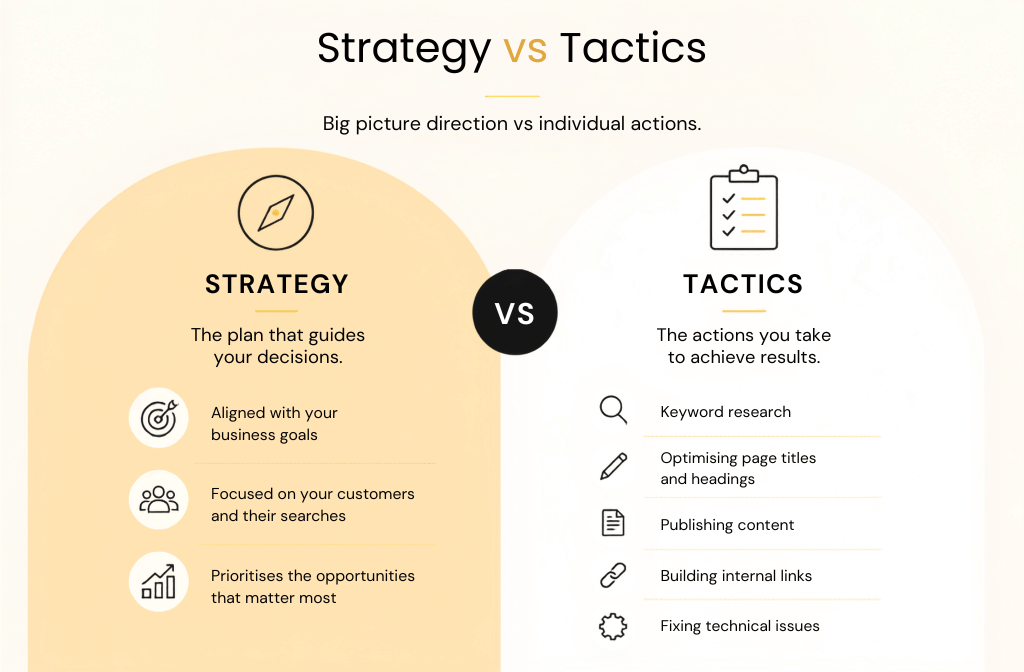
The important distinction is that SEO tactics are the individual actions, while your SEO strategy is what tells you which actions matter and why. You don’t necessarily need to do everything at once. In fact, trying to optimise everything at the same time can make it harder to know what is actually making a difference.
A better starting point is understanding where your website is now, where you want it to go and what opportunities sit between the two.
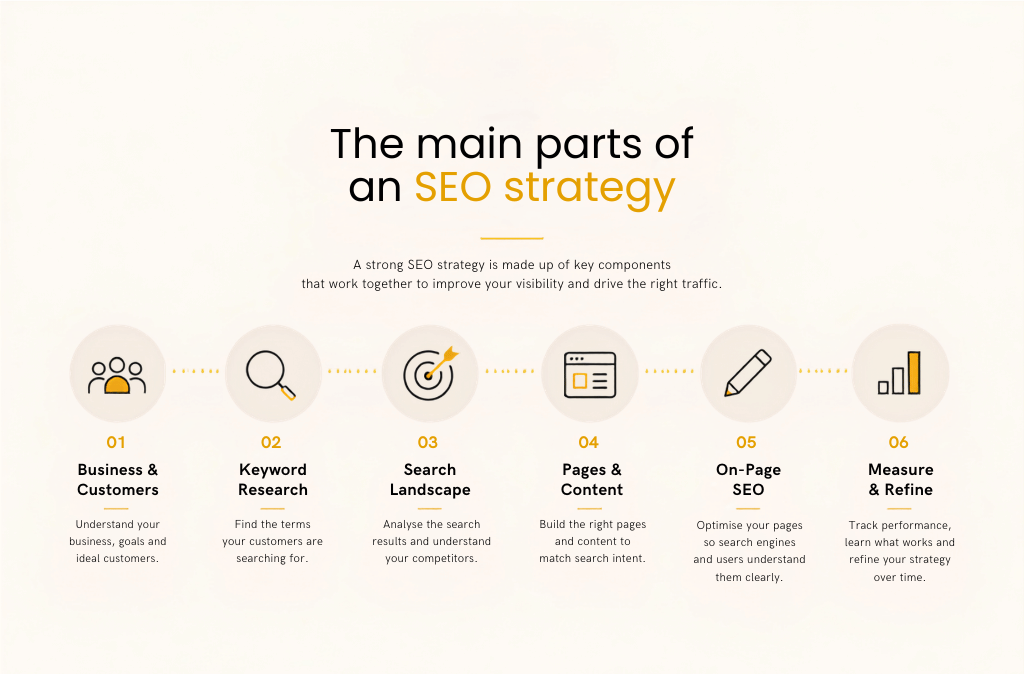
There isn’t one fixed formula for an SEO strategy. The right approach depends on your business, your customers, your website, your competitors and the searches you want to be visible for. There are, however, several areas that commonly come together when building a strong approach to SEO.
SEO should start with your business, not a keyword tool. Before deciding what to optimise, you need to understand what you actually want your website to achieve. That could mean generating more enquiries for a particular service, reaching customers in a specific location, building visibility around an area your business wants to grow or attracting people who are actively researching what you offer. From there, consider who your customers are, what they need and what they are likely to search for when they’re looking for a business like yours. This gives your SEO strategy a much stronger foundation than simply choosing keywords with the highest search volume.
Keyword research helps you understand the language people use when searching for your products or services, but a keyword on its own doesn’t tell you everything.
You also need to understand search intent: what someone actually wants when they make that search. For example, someone searching for “local SEO services” is likely looking for a provider, while someone searching for “what is local SEO” is looking for information.
Both searches relate to the same topic, but they represent different needs. One may be closer to making a decision, while the other may be at an earlier stage of research.
Your SEO strategy should account for those differences. The goal isn’t to collect as many keywords as possible. It’s to understand the searches that are relevant to your business and the pages that can genuinely answer them.
Your SEO strategy doesn’t exist in isolation. It’s useful to look at what is already appearing in search results for the topics and services you want to be visible for.
This can show you what types of pages are appearing, what questions are being answered and where competitors are already gaining visibility. It can also reveal opportunities. Perhaps the current results don’t properly answer a particular question, or perhaps competitors have strong service pages but very little supporting content.
Competitor research isn’t about copying another business. It’s about understanding the landscape you’re entering so you can make better decisions about your own website.
Once you understand what your customers are searching for, you can consider whether your website has the right pages to meet those searches.
For a service business, this might mean making sure your core services have dedicated pages that clearly explain what you offer, who it’s for and what someone can expect. It could mean creating location pages where there is a genuine local opportunity, or developing useful resources that answer questions your potential customers are asking.
The goal isn’t to create a page for every keyword you find. Each page should have a clear purpose and give the person who lands on it a useful answer.
On-page SEO helps search engines and people understand what your pages are about. This includes elements such as page titles, headings, content, URLs, internal links, image alt text and meta descriptions, as well as how clearly the page addresses the searcher’s intent.
These details work together. If a page is targeting a particular service, for example, it should be immediately clear what that service is, who it is for and why the page is relevant to the person who found it. Google recommends clear, descriptive page titles, useful headings and descriptive link text because these elements help people and search engines understand your pages.
Content can play an important role in an SEO strategy, particularly when it’s written with purpose. SEO copywriting helps turn those opportunities into clear, useful pages and resources that answer the questions your potential customers are asking. But more content isn’t automatically better.
Publishing a new article every week won’t necessarily improve your SEO if the content doesn’t have a clear purpose or add anything useful. A stronger approach is to identify the topics that matter to your customers and your business, then create content that genuinely helps people understand, compare or solve something.
That might include guides, FAQs, how-to resources, explanations or comparisons related to your services. Your content should also have somewhere useful to lead the reader. A resource about local SEO, for example, might naturally lead to a relevant Local SEO service page.
This creates a clearer journey through your website while helping search engines understand how your content and service pages relate to one another.
Your website also needs to be accessible and understandable for search engines. This doesn’t mean every business needs a huge technical SEO project. A sensible SEO strategy should at least consider whether important pages can be found and indexed, whether there are obvious errors or broken links, whether redirects are working correctly and whether key SEO elements are in place.
These checks can help identify issues that may be getting in the way of your broader SEO efforts. Not sure what’s happening beneath the surface of your website? Our Website Health Audit can help you understand what’s working, what needs attention and what to prioritise next.
Knowing what an SEO strategy includes is one thing. Knowing where to start is another.
A sensible implementation process begins with understanding your current position. Review your website, existing content and current search performance. Look at which pages are already receiving visibility, which searches you’re appearing for and whether there are obvious gaps or issues affecting important pages.
Google Search Console can provide useful information about how your website performs in Google Search, including the queries and pages generating impressions and clicks.
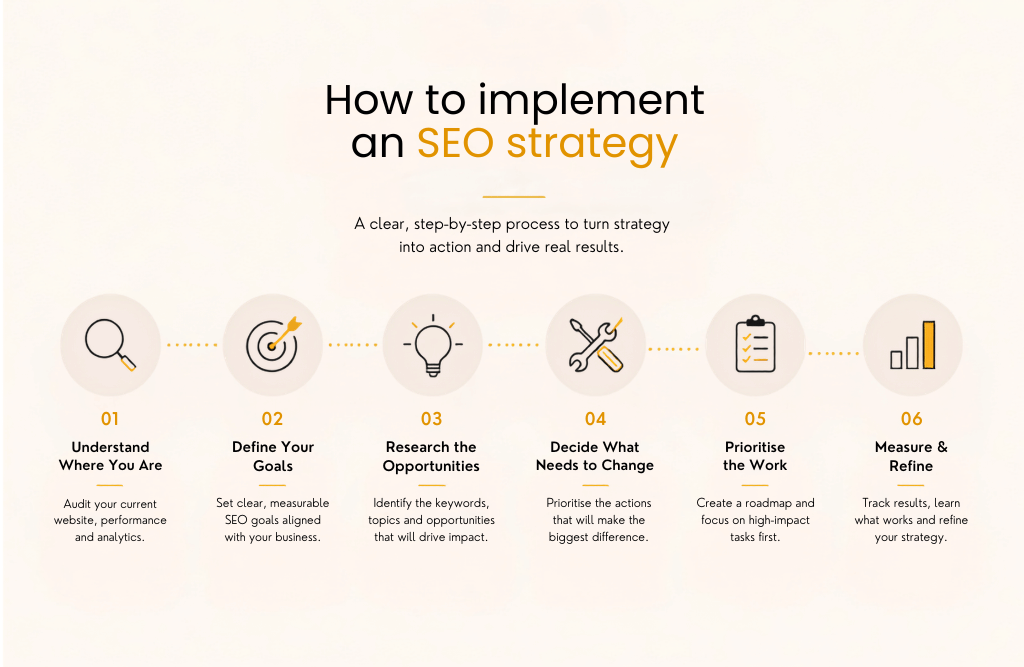
Your SEO goals should connect to your business goals. If one service is particularly important to your business, for example, it may make more sense to improve the visibility and relevance of that service page than to spend time creating unrelated content. A clear goal makes it easier to decide what deserves attention and what can wait.
Next, research your customers, keywords, search intent and competitors. Look at what people are actually searching for and what appears in the results. This gives you the information you need to decide which topics, pages and searches are worth pursuing.
Now you can turn the research into actual SEO work. That could involve improving existing service pages, creating new content, strengthening internal links, addressing website health issues or improving on-page elements. Not every recommendation will apply to every website. That’s why strategy matters.
You might find ten things you could change, but that doesn’t mean all ten need to happen at once. Separate the work into what needs attention now, what could have an impact later and what isn’t currently worth your time. Prioritisation is one of the most important parts of implementing an SEO strategy because it keeps your efforts focused on the opportunities that matter most.
SEO doesn’t stop when the changes are made. Monitor what happens, look for changes in search visibility and use the information you gather to decide what should happen next. Search visibility is useful, but it isn’t the end goal. Where possible, your SEO strategy should also consider whether the work is contributing to the enquiries, leads or other business outcomes you actually care about. Your strategy can change as your business changes, your website develops, your competitors move and the search landscape evolves.
If you’ve already been working on SEO but aren’t seeing the results you expected, the answer isn’t always to do more. Sometimes the strategy needs another look.
Start by asking whether you’re targeting searches that actually relate to your business and whether the pages you’re sending people to genuinely meet those searches. Look at your most important pages. Are they clear? Are they aligned with search intent? Are they internally linked to relevant content? Are there gaps that your competitors are addressing? Then look at the work you’re producing. Are you creating content because your customers need it, or simply because you feel like you need to publish something? Finally, look at your priorities. You may be spending time making small changes while more important opportunities are being overlooked.
Improving your SEO strategy often comes down to making better decisions about where your time, attention and resources should go.
A good SEO strategy should give you clarity. You should understand what you’re trying to achieve, who you’re trying to reach, which searches matter to your business and why you’re prioritising certain work over other opportunities. It should also be realistic. You don’t need to chase every keyword, publish endless content or make every possible website improvement. Your strategy should reflect your business, your customers, your website and the opportunities available to you.
Most importantly, it should give your SEO work direction. Without that direction, it’s easy to spend time making changes without knowing whether they’re contributing to anything meaningful.
There is no shortage of SEO advice telling you what you should be doing. The harder part is working out what your business should be doing. That’s what an SEO strategy is there to help with. It connects your business goals, your customers, your website and search opportunities so that your SEO work has a clearer purpose. You might not need to do more SEO. You might just need a better idea of where to focus next.
Understanding what SEO strategies are is one thing. Knowing which strategies make sense for your business is another. We can help you identify the opportunities that matter, prioritise the work and build a clearer path forward.
You might be doing SEO already. But do you know if it’s actually working? You may have spent time researching