
A clear direction for your organic search.
SEO shouldn’t start with a list of things to do.
It should start with understanding what you’re trying to achieve, who you’re trying to reach and what your website needs to do to support the business.
We research your market, your customers, your competitors and your website to understand where search can genuinely present an opportunity, then use what we find to determine where the work should focus.
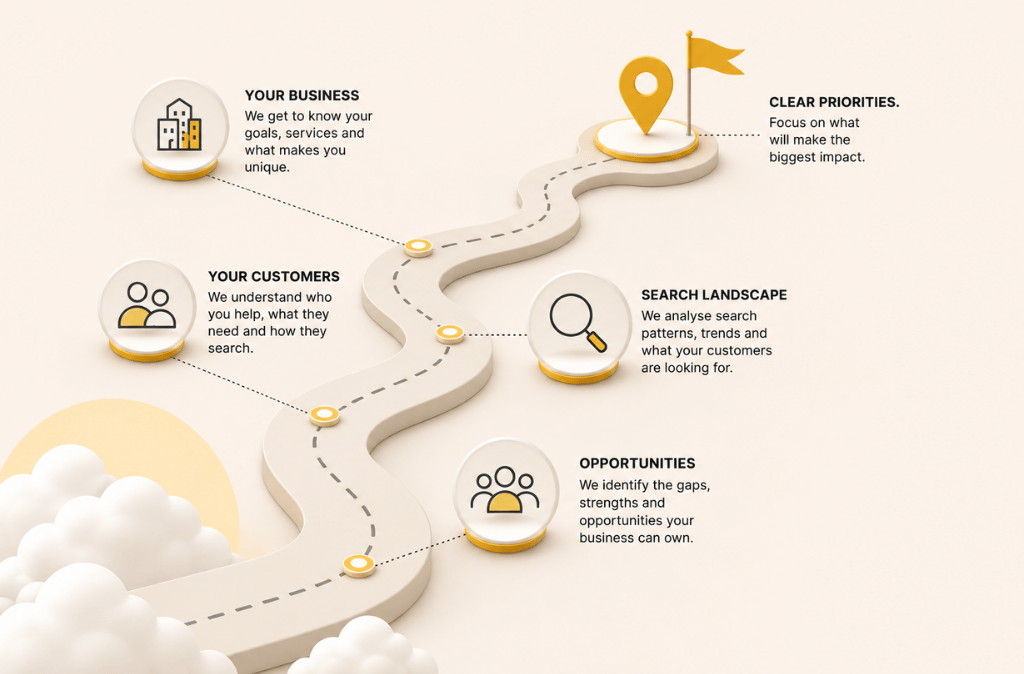
What is SEO strategy?
An SEO strategy is the plan behind your SEO. It brings together the information we need to understand where your business currently stands, what people are searching for and where there is potential to improve your organic visibility.
That means looking beyond individual keywords or isolated website changes. We consider how your services, website, content, customers and competitors fit into the wider search picture.
From there, we can decide what deserves attention and what doesn’t. Because there will always be more SEO work you could do. The value of a strategy is knowing which work is worth doing first.
What goes into an SEO strategy?
Every strategy starts from a different place. We look at the areas that can give us the clearest picture of your search visibility and where there may be room to improve.
1. Your business and goals
SEO needs to have a reason behind it. We look at what you’re working towards, which services matter most to your business and what you want your website to achieve. This gives us the context to assess search opportunities against something more meaningful than rankings alone.
2. Your customers and search intent
People don’t search for businesses in exactly the same way they describe themselves. We research how your customers search, the questions they ask and what they are trying to find. Understanding that intent helps us identify where your business can provide the right answer at the right stage of their search.
3. Keyword research
We research the terms, topics and questions relevant to your services and your market. The aim isn’t to collect as many keywords as possible. It’s to understand which searches are relevant to your business, what sits behind them and where there is a genuine opportunity to be visible.
4. Competitor research
We look at the businesses appearing in search for the terms and topics that matter to you. This helps us understand how your market is represented online, what competitors are doing well and where there may be gaps or opportunities worth exploring.
5. Your website
Your website is part of the strategy, not something we look at separately. We consider how your pages are structured, how clearly they communicate your services, what is already performing well and whether anything may be making it harder for search engines or people to understand what you offer.
6. Opportunities and priorities
Research can uncover a long list of things you could change. We don’t believe that means you should change all of them. We assess the findings, consider their potential value and establish priorities for the wider campaign. That gives the work an order and helps keep the focus on what is most relevant to your business.
Strategy before activity
We use research to understand where your strongest opportunities are, then build the strategy around the areas that are most relevant to your business.
That might mean improving existing pages, creating new content, strengthening internal linking, addressing technical issues, improving your local presence or building your site’s authority.
The strategy gives those activities a reason to exist. It helps us understand what we’re doing, why we’re doing it and how each part contributes to the wider campaign.
The way we approach SEO is shaped by the principles behind our SIGNAL Framework.
What your SEO strategy gives you
Your strategy gives you more than a list of SEO recommendations. It gives the wider campaign a basis for making decisions.
You’ll understand where the opportunities are, what we recommend prioritising and why those areas deserve attention. The strategy can then guide the work across your website, content, local search, technical SEO, internal linking and other areas where there is an opportunity to improve your visibility.
Not every business needs the same work. That’s why we don’t start with a fixed list of tasks and work through it regardless of what we find. The research comes first, and the strategy reflects what your business actually needs.
FAQs
Your questions, answered.
SEO can raise a lot of questions. Here are some of the ones we hear most often.
What is an SEO strategy?
An SEO strategy is the plan behind your SEO. It brings together research about your business, customers, competitors, search behaviour and website to identify opportunities and establish priorities for the work ahead.
Why do I need an SEO strategy?
Without a strategy, SEO can quickly become a collection of disconnected tasks. A strategy helps determine what is worth focusing on, what can wait and how the different parts of your SEO work should support the wider business.
What does an SEO strategy include?
The exact focus will depend on your business and what we find through research. An SEO strategy can include business and competitor research, keyword research, search intent, website analysis, content opportunities, technical considerations and priorities for ongoing SEO work.
How long does an SEO strategy take?
The time involved depends on the size of your website, your market, your current search visibility and the amount of research needed. We take the time required to understand the situation properly rather than applying the same process to every business.
Will you implement the SEO strategy?
Yes. SEO strategy forms part of the wider SEO work we provide. The strategy guides what we prioritise across areas such as website optimisation, content, local SEO, technical improvements and ongoing SEO. You won’t be left with a strategy document and a list of tasks to work through on your own.
Ready to give your SEO a clearer direction?
Let’s talk about where your business is now, what you’re working towards and where search could support it.